
An insert quote that lists only the unit and the labour is missing half the job. The firebox gets the new box, but the work that keeps it safe happens inside the flue and at the top of the chimney. On houses across Los Angeles the same handful of extra items keeps coming up: the liner, the old damper, the cap, the crown, and on framed chimneys the lid over the chase. Below is what each one is, why it shows up during an insert job, and which can wait.
The liner
Every insert vents through its own pipe from the unit to the top of the chimney. A wood insert takes a stainless liner the whole height, often wrapped in insulation where the gap to framing is tight. A gas insert takes two slim aluminium pipes, one out and one in. A pellet insert takes a narrower vent. The liner is the largest add on in most insert jobs, and its cost rises with every foot of stack and with each bend the pipe must follow. On a chimney that will keep an open fireplace, a liner can also be fitted on its own to replace broken clay tiles. The chimney liner installation page covers both.
The old damper
Most older Los Angeles fireplaces have a cast iron damper at the throat, just above the firebox. It sits exactly where the insert vent has to pass. On most jobs it comes out, or the plate and part of the frame are cut away, so the pipe goes through cleanly and the seal at the top does the damper's work from then on. Where a second fireplace in the house stays open, its damper may need attention of its own: a warped plate or a seized handle lets warm air escape all winter. Our chimney damper repair work covers both cases.
The cap
A new liner ends under a cap. Without one, rain runs straight down the vent and onto the insert's top, and birds and squirrels move in. A cap is quoted after we measure. The simplest job is a single flue with easy roof access; a large cover over several flues or a custom size costs the most. Flue count, cap size and metal decide the price. See the chimney cap installation page.
The crown
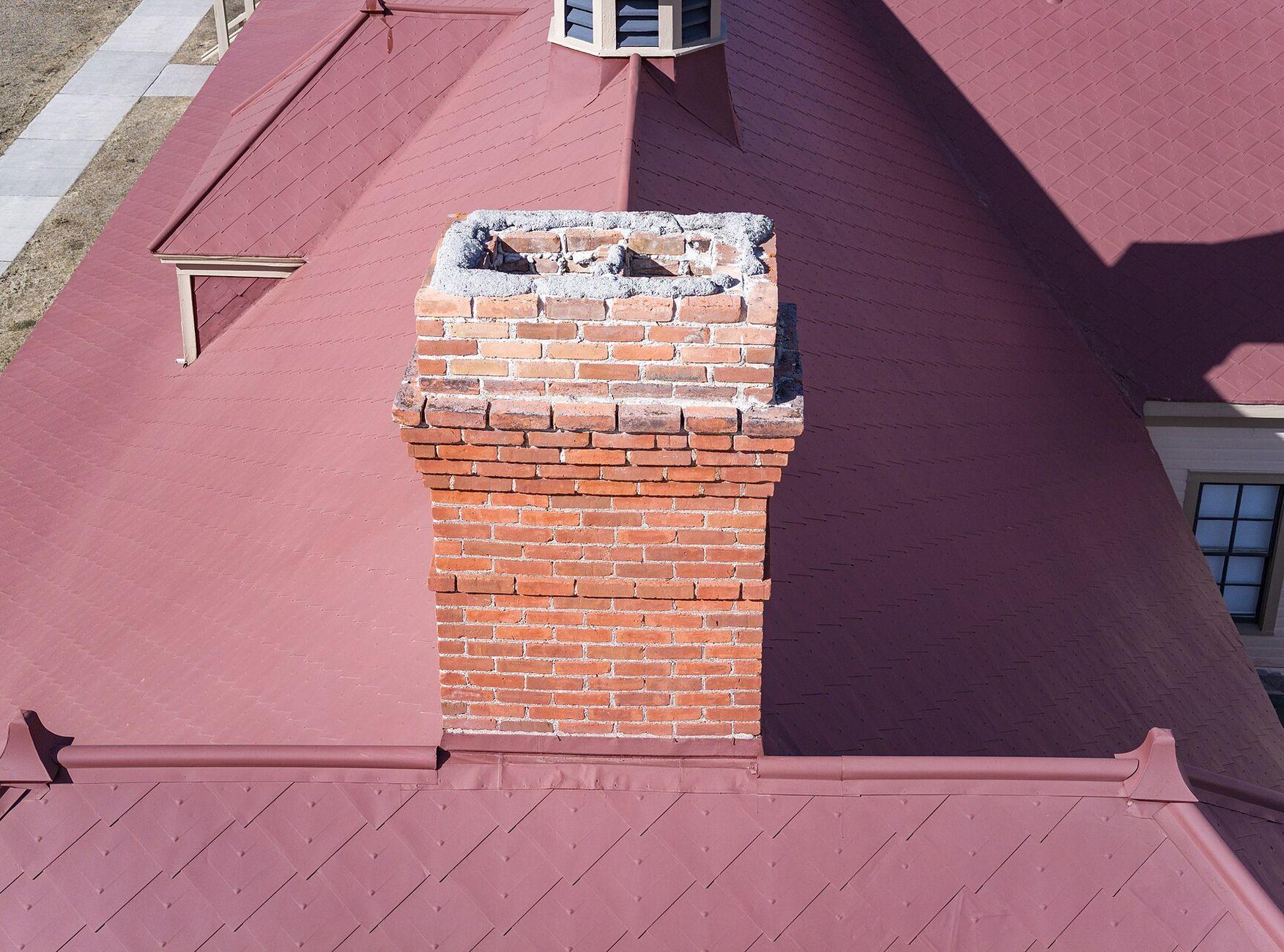
The liner's top plate seals to the crown, the concrete slab at the top of a brick chimney. If that slab is cracked or crumbling, water gets in around the plate and runs down outside the liner, where nobody sees it until the brick or the ceiling shows it. A crown with surface wear can be patched and coated; one broken through has to be cast again. Either way it gets fixed before the liner seals to it. The chimney crown repair page has more.
The chase lid on framed chimneys
Some Los Angeles houses built from the 1970s onward have no brick chimney at all. The flue is a metal pipe inside a framed box on the outside wall or above the roof, and a sheet metal lid closes the top of that box. When the lid rusts or sags, water collects and finds its way inside. An insert into a factory built fireplace is only possible with a unit listed for that box, and a failing lid is fixed first. The chimney chase cover page covers the replacement.
Water already getting in
If there is already a stain near the fireplace, find the leak before the insert goes in, or the new unit takes the blame for an old problem. Tracing and fixing a chimney leak runs $590 to $3,550 on our list, depending on where the water enters and what it has damaged. Brick that soaks up rain can also be treated with a breathable sealer once repairs are done; see chimney leak repair and chimney waterproofing.
What goes with the insert, and what can wait
| Item | Do it with the insert | Fine to leave for later |
|---|---|---|
| Liner or vent pipe | Always | Never |
| Old throat damper | When it blocks the vent, which is most of the time | Not applicable |
| Cap | Always, over the new vent | Never |
| Crown | When cracked where the liner seals | Light surface wear, watched each year |
| Chase lid | When rusted through or holding water | Surface rust only |
| Masonry sealer | Not needed for the fit | Yes, a later season |
| Active leak | Always first | Never |
What we publish and what we price on the visit
From our price list: a gas insert fitted to the existing firebox runs $2,950 to $5,900, and leak tracing and repair $590 to $3,550. A cap is quoted after we measure the flue. Liner work on its own, damper work, crown work and chase lids all carry a written figure from the visit, since their size changes from house to house. On an insert job, each of those shows as a separate line beside the unit, so you can see what is the upgrade and what is the chimney.
Ask for a quote on the full job and mention anything you already know about the chimney top, such as a missing cap or a stain near the fireplace, so we come ready for the roof work.
Questions about the extra items
Can the cap and crown wait until after the insert? No. The liner seals to them, so they come first or at the same visit.
Does a gas insert need the same top work as wood? Mostly yes. Its pipes still run to the top and seal under a cap.
Will removing the damper hurt the house if I later go back to an open fire? Going back would mean a new damper or a top sealing one; we would price that at the time.
For planning the whole upgrade, read insert costs for Los Angeles homes. To book the measuring visit and the roof check together, use the contact page.
Weighing the Same Choice at Home?
Farrell Chimney Pros fits wood, gas and pellet inserts, gas log sets and liners, and handles the chimney work that has to come first. We visit homes in Los Angeles, Rosemead, South Pasadena, Downey and the cities around them.